
MEDIA RELEASE
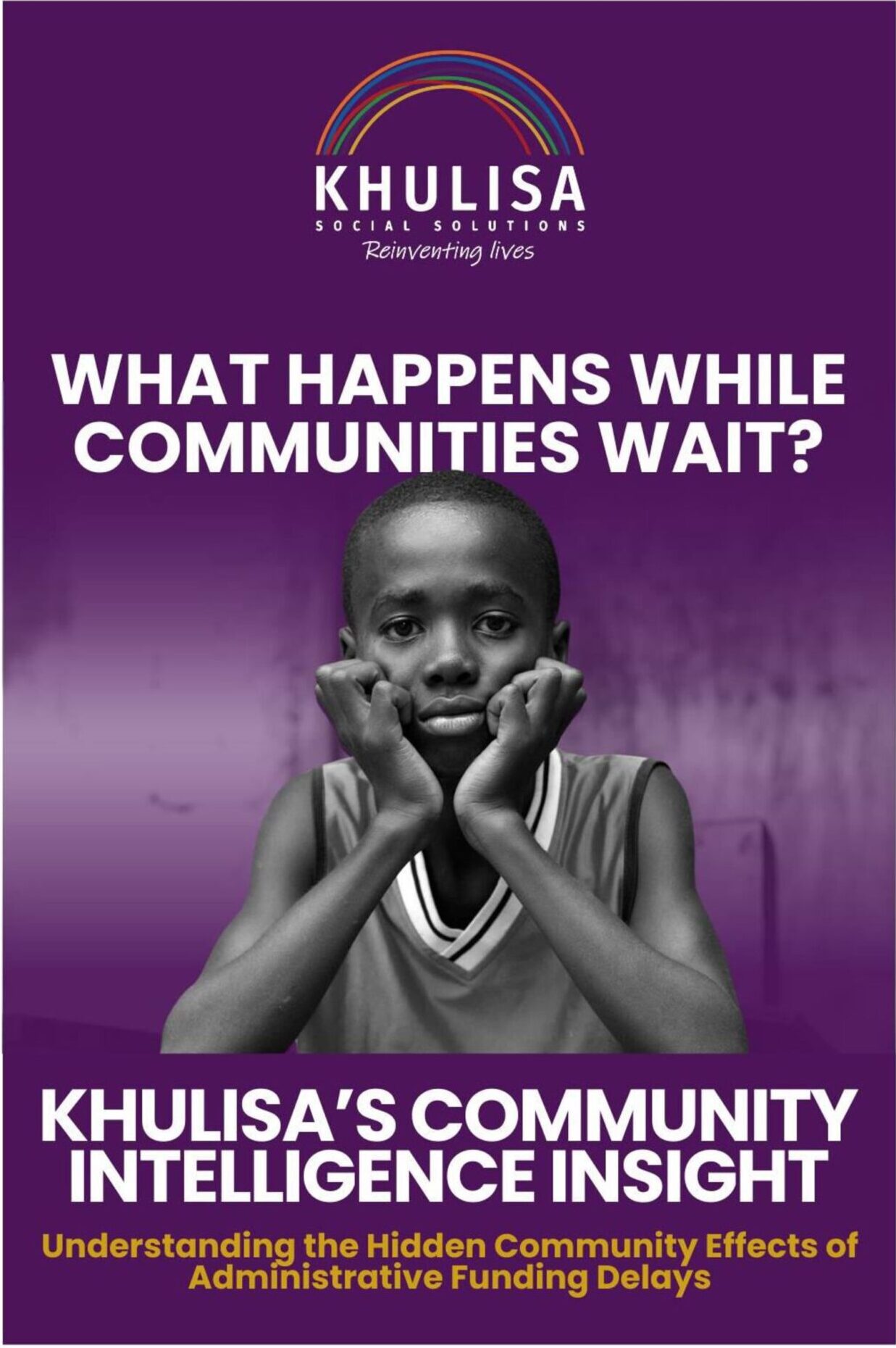
What Happens While Communities Wait?
New AI-Assisted Community Intelligence Study Reveals the Hidden Human Cost of Funding Delays
Johannesburg, South Africa
FOR IMMEDIATE RELEASE
While much attention is rightly given to ensuring that donor funding is managed responsibly and reaches communities with appropriate governance and accountability, far less attention has been paid to an important question:
What happens to vulnerable communities while approved funding is delayed by administrative processes?
A new Community Intelligence Insight released by Khulisa Social Solutions provides a unique answer.
Using its proprietary Systemic Intuitive Thinking (SIT) methodology alongside AI-assisted Community Intelligence analysis, Khulisa facilitated Dialogue Circles with eight community-based organisations that had experienced significant delays in receiving committed funding.
Rather than examining financial systems or compliance procedures, the study posed a simple yet powerful question:
“What changed in your communities while everyone was waiting?”
The findings reveal a dimension of social development that is rarely captured through conventional monitoring and evaluation systems.
“We were not looking for evidence of financial hardship,” explains Lesley Ann van Selm, Founder and Managing Director of Khulisa Social Solutions. “Instead, what emerged was a much deeper understanding of how administrative delays ripple through organisations, families and communities. It became clear that the real story was not about finance; it was about relationships, confidence and trust.”
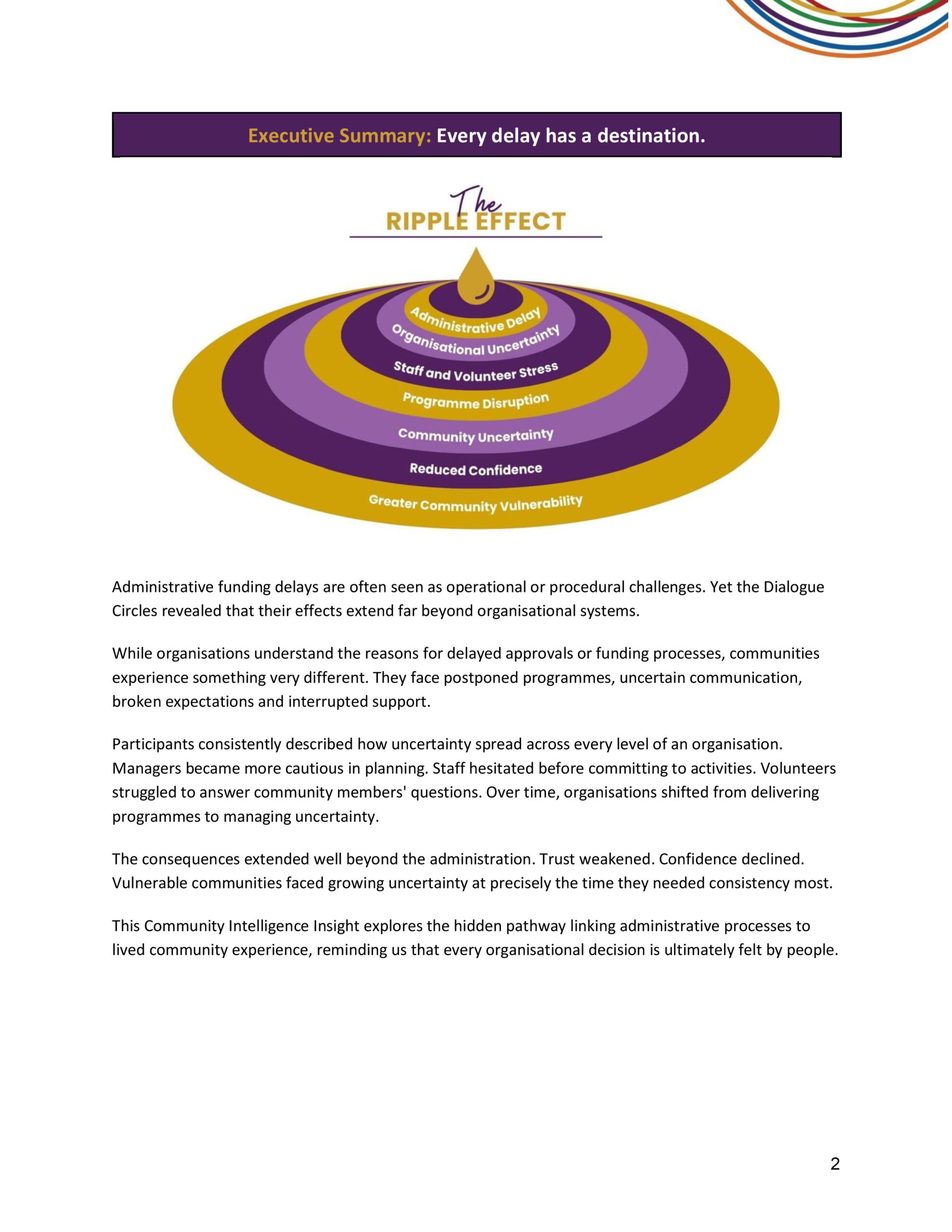
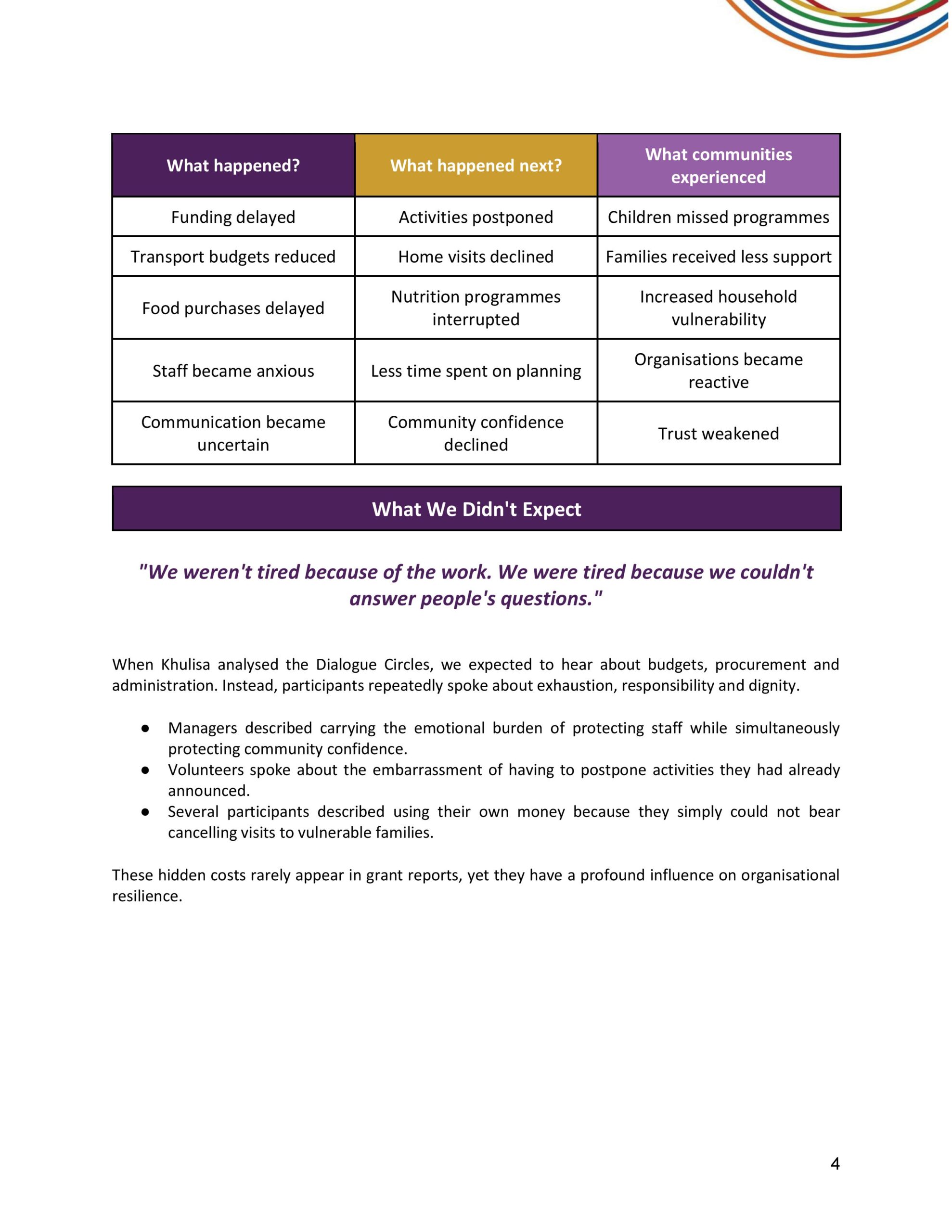
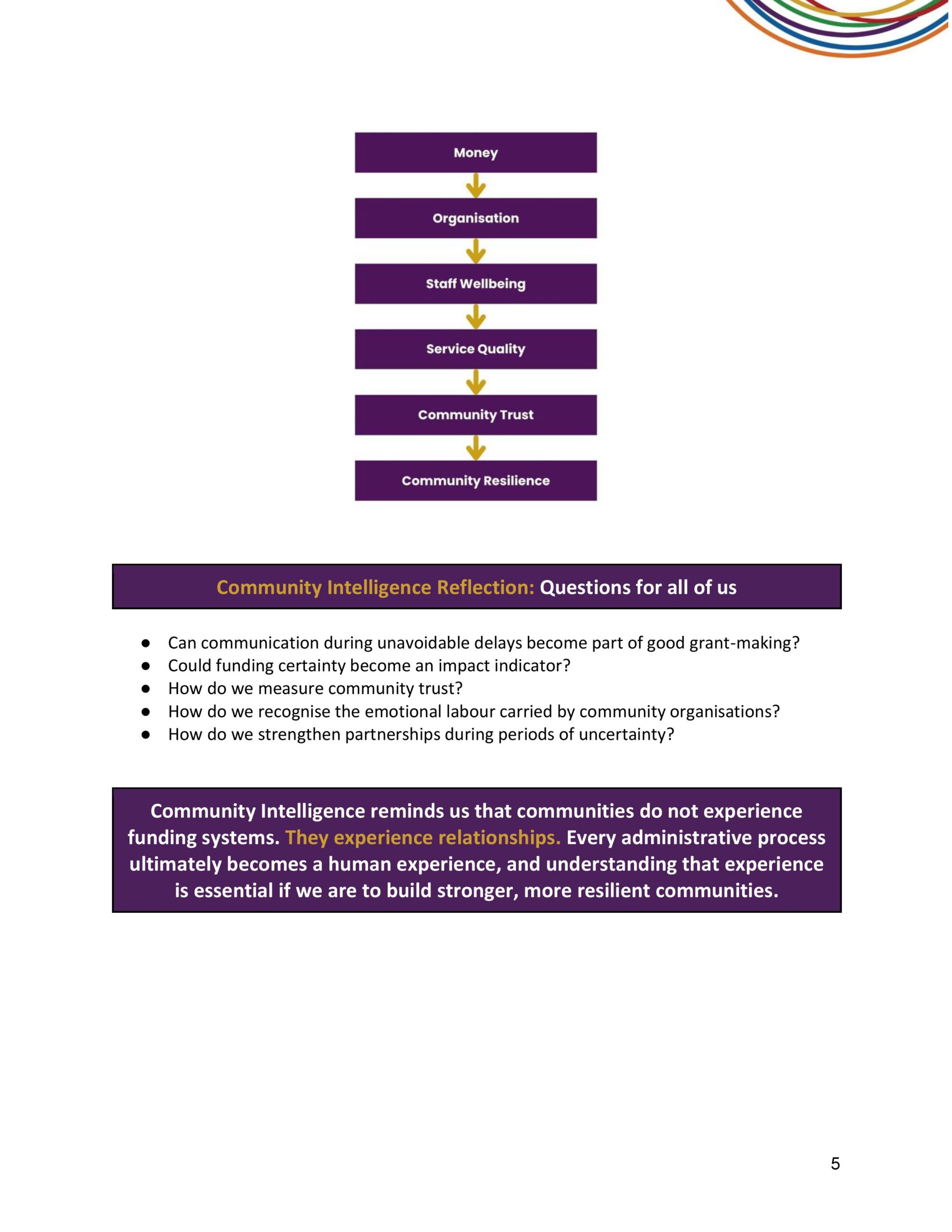
Initially, participating organisations absorbed the impact by drawing on limited reserves, using personal resources and adapting programme plans to keep services running. As delays continued, the effects spread beyond organisational operations. Staff experienced increasing uncertainty, volunteers continued serving despite financial pressures, families adjusted household budgets, and community programmes became increasingly difficult to sustain. Ultimately, beneficiaries themselves experienced reduced services, postponed activities and uncertainty about whether support would continue.
One participant captured the experience simply:
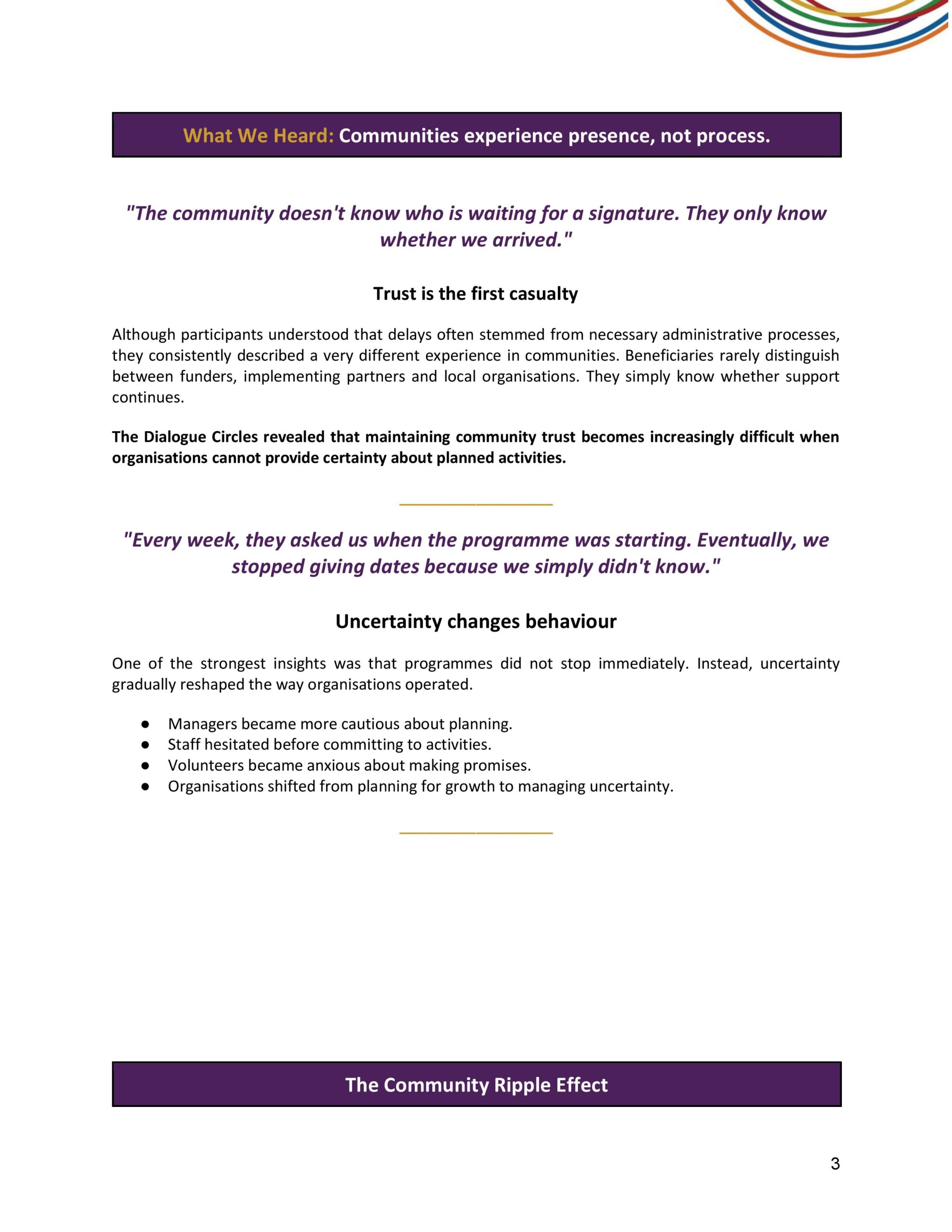
“The community doesn’t know who is waiting for a signature. They only know whether we arrived.”
The study concludes that communities experience development as one interconnected system. They do not distinguish between donors, implementing partners, government departments or community
organisations. Their experience is shaped by whether support remains consistent and whether trusted relationships are maintained.
Importantly, the report does not suggest that governance or compliance should be weakened. On the contrary, robust financial controls remain fundamental to responsible stewardship of development funding.
Instead, the findings demonstrate that administrative systems also have human consequences that deserve greater recognition.
Using AI-assisted analysis across the dialogue findings, Khulisa identified recurring patterns showing that prolonged uncertainty can gradually erode organisational resilience, staff wellbeing, community confidence and participation long before programmes are formally interrupted. These impacts seldom appear in financial reports, yet they can significantly influence long-term social outcomes.
“Our intention is not to criticise funders,” says van Selm. “Administrative processes exist for very good reasons, and every trust, foundation and corporate donor has governance responsibilities. Our Community Intelligence work simply demonstrates that there is an opportunity to strengthen those systems further by understanding how communities experience them. Better communication, transparency and predictability can be just as important to community resilience as funding itself.”
Beyond highlighting the impact of funding delays, the report demonstrates the value of Khulisa’s Community Intelligence methodology. By combining facilitated Dialogue Circles, Systemic Intuitive Thinking and AI-assisted analysis, the approach captures lived experience, identifies systemic patterns and provides decision-makers with actionable intelligence that traditional monitoring systems often fail to reveal.
The report concludes that the next frontier in social investment lies not only in measuring where money is invested, but in understanding how communities experience the systems that deliver those investments.
For Khulisa, this is the essence of Community Intelligence: transforming lived experience into evidence that strengthens programmes, partnerships and ultimately community resilience.
About us
Khulisa Social Solutions is a South African social cohesion and community development organisation founded in 1997. The organisation works nationally to strengthen vulnerable communities through restorative practices, NGO capacity-building, dialogue processes, youth development, psychosocial support, skills development, and collaborative ecosystem partnerships. Khulisa’s work focuses on addressing the systemic root causes of social dysfunction by building stronger relationships among communities, government, civil society, and the private sector.
For more information, contact:
Lesley Ann van Selm | Managing Director and Founder
Khulisa Social Solutions
082 601 2299

