
Case Study
ALEX PEACE-MAKING PROJECT CASE STUDY: 2022 TO 2024
SA’S SOCIO-ECONOMIC SITUATION CALLS FOR MORE NGOS TO BE CAPACITATED WITH PEACE-MAKING SKILLS

NGOs appreciate peace-making in addressing societal problems; however, many organisations need to be trained to better deal with the various sociological challenges in communities.
Abstract
In marginalized communities and townships across South Africa, crime continues to demolish the lives of countless people and their families. Despite the strides taken in post-apartheid South Africa, our country is eroded by appallingly high crime rates. To solve the issue, many believe that the solution is to utilize the law to ensure more arrests and prosecutions and enforce harsher penalties. However, it is evident from the unbearable crime statistics that the current methods employed to combat crime are wholly insufficient and that our criminal justice system needs meaningful reform.
Those actively seeking an alternative method of reform have increasingly pointed to the concept of restorative justice, an approach to justice that is rooted in community involvement and accountability. The concept is a relatively new phenomenon in South Africa that is fast gaining traction among justice advocates for communities. However, our criminal justice system has been slow to adopt this approach.
Against this backdrop, this proposal aims to highlight the effectiveness of the Khulisa Social Solutions (Khulisa) Peace-Making Project piloted in Alexandra (Alex). The study used qualitative data sources and methods of analysis to ascertain the causal factors of the violence in Alex as well as to find solutions to rebuild social cohesion.
This summary is an attempt to amplify the need to rethink the criminal legal system and infuse restorative justice as a touchstone for the criminal justice system by using the Peace-Making Project in Alex as a case study.
About Khulisa
The genesis of Khulisa Social Solutions dates back 27 years ago when internationally acclaimed cultural historian, Credo Mutwa, joined forces with CEO and Founder of Khulisa, Lesley Ann van Selm, to pioneer South Africa’s first official juvenile offender rehabilitation programme at Leeuwkop prison, in October 1977.
Today, Khulisa Social Solutions (KSS) is a national multi-award winning, Non-Profit Organisation (NPO). It aims to empower vulnerable children, youth, those who are marginalized, and the community at large to unlock their full potential to develop resilient pathways and skills that lead to a sustainable future. We operate nationally, currently employ over 180 staff through 19 offices, and in the past financial year worked in approximately 150 communities in collaboration with 350 NGO partners, impacting the lives of close to 200,000 people.
Through promoting social cohesion, Khulisa capacitates individuals, the community, local government and NGOs/CBOs to roll out activities to create inclusive and collective spaces through experience sharing, cultural appreciation, acquisition of knowledge, development of innovation, resilience building, and conflict resolution. Our programmes serve to equip and empower people with actionable knowledge to promote active citizenship, entrepreneurship, job creation, employment and innovation.
The Problem
Recent crime statistics by the Department of Police show that a total of 6,289 people were murdered between January and March 2023, this is an increase of 206 from the same period in 2022. A total of 49,226 assault cases were registered, increasing by 3,480 from the same period in the previous year.
To further underscore the challenges in communities, in the second half of 2022, Khulisa used the ecological model to investigate the complex root causes of gender-based violence (GBV) in communities and to recommend the ideal solutions to productively deal with GBV-related issues in affected communities. In addition to the obvious risk factors that are known to influence trauma and abuse in households, the study uncovered a myriad of other influences that are least acknowledged or known in communities. The list of risk factors is provided in the table below:
Risk factors for violence based on the Ecological model
Societal
Broad factors that reduce inhabitations against violence
- Poverty
- Economic, social and gender inequalities
- Poor societal security
- Masculinity linked to aggression and dominance
- Weak legal and criminal justice system
- Perpetrators not persecuted
- No legal rights for victims
- Social and cultral norms support violence
- Small fire arms
- Conflict or post conflict
- Internal displacements and refugee camps
Community
neigbourhood, schools and work places
- High poverty
- High population density
- Social isolation of females and family
- Lack of information
- Inadequate victim care
- Schools and work places not addressing GBV
- Weak community sanctions against GBV
- Poor safety in public safes
- Challenging tradittional gender roles
- Blaming the victim
- Violating of confedentiality
Relationships
With family, intimate partners and friends
- Family disfunction
- Intergenerational violence
- Poor parenting practices
- Parental conflict involving violence
- Association with friends who engage in violent or delinquint behaviour
- Low socio economic status socio-economic stress
- Friction over womens empowerment
- Family honor more important than female health and safety
Individual
Personal factors that influence individual behaviour
- Gender, age and education
- A family history of violence
- Witnessing GBV
- Victim of child abuse or neglect
- Lack of sufficient livelihood and personal income
- Unemployment
- Mental Health and behavioural problems
- Alcohol and substance abuse
- Prostitution
- Refugee internally displaced
- Disabilities
- Small fire arms ownership
Police Minister General Bheki Cele stressed that the challenges facing communities, especially crime and violence, high unemployment, and the increasing number of informal settlements, are some of the factors that lead to gender-based violence – mentioned above, unhealthy parenting patterns, traumatised youth, teenage pregnancy, poor academic performance, drug abuse, bullying, and other social ills.
Considering this, Khulisa firmly believes that unless measures are taken to provide communities with relevant remedial interventions to address the root causes of such dysfunctionality, the downward spiral will continue. This is supported by the data generated by Khulisa, and other sources, from a variety of methodologies over the past three years, reaching over 4,000 children nationally to generate evidence-based solutions to conflictual situations and issues contributing to mental illness.
Our Functional Strategy – Working in Geographic Eco-Systems
Khulisa’s approach to developing socially cohesive communities is the co-creation of solutions to address problems at a grassroots level through a multi-stakeholder and intersectoral approach and the establishment of multiple partnerships.
A specific emphasis is placed on the capacitation of local NGOs, many of whom remain invisible in their communities and doing invaluable work, whilst, due to the lack of funding, adequate governance structures, capacitation, and operational costs, will never be viable vehicles for donor investment.
We believe that by providing such entities with relevant skills, they will become valuable implementation partners in rendering multiple services against a fee, enabling us to reach increased numbers of audiences and demographics.
The Role of Restorative Justice and Peace-Making in Promoting Social Cohesion
Over the past 26 years Khulisa, through various restorative justice interventions, primarily having been facilitated by trained community-based mediators, have through dialogue, addressed criminal and abusive behaviour by understanding the underlying causes that have led to complex social interactions.
This is evidenced by research done on the effect of adverse childhood experiences which unless addressed at an early stage, lead to toxic behaviour. The solution to this requires a multifaced approach which can only be achieved by collaborative approaches, provided primarily through capacitated NGOs.
Based on our study, which utilised the ecological model to better understand the myriads of risks contributing to GBV, we noted the following factors which can lead to the continual cycle of GBV:
- Lack of information and active solutions to addressing the abuse and violence.
- Early exposure to the abuse, especially GBV.
- Dire socio-economic circumstances.
- Lack of discourse to address the problem at hand.
- Limited or no resources to deal with the trauma experienced by the victims.
Our Success Story in Alexandra
For the past 22 years, Khulisa Social Solutions (Khulisa) has been actively working with the community in Alexandra to help eradicate crime, inequality, poverty, and violence. However, in July 2021, South Africa experienced violent protests and socio-political unrest. The community in Alexandra was faced with widespread looting of local shops and the burning and destruction of public facilities and private homes. The community was not only fighting the rest of the country, but they were also fighting one another.
In July 2021, Khulisa began to facilitate a peace mediation process targeted at the looters, victims, shop owners, children, those whose family members were murdered, members of the LGBTQIA+ fraternity, people with disabilities, foreign nationals, and NGOs to ascertain the causal factors of the violence and what solutions the community was able to propose to rebuild social cohesion. This culminated in the conception of the Alex Peace-Making Programme.
Various data sources and methods of analysis were utilised to explore the factors contributing to violence in Alex and their impact, from the perspective of community members, as well as provide an opportunity for them to contribute to recommendations that inform Khulisa’s programming for peace-making and social cohesion.
The analysis suggests that violence prevention, through the peace-making programme is necessary across multiple levels of any community ecology. The findings draw attention to the fact that although there is still fragmentation (in terms of race, crime, and inequality) within South Africa, there are pockets of unity and active citizenship that can be ignited through strength-based programming and support.
The perceptions shared by community members provided a valuable source of insight into factors contributing to violence in communities (see diagram below), their impact on members, and their proposed solutions. The collaborative and interactive opportunity provided Khulisa with the ability to develop an Ecological Model for the identification of risk factors for violence and a model for change (Theory of Change).
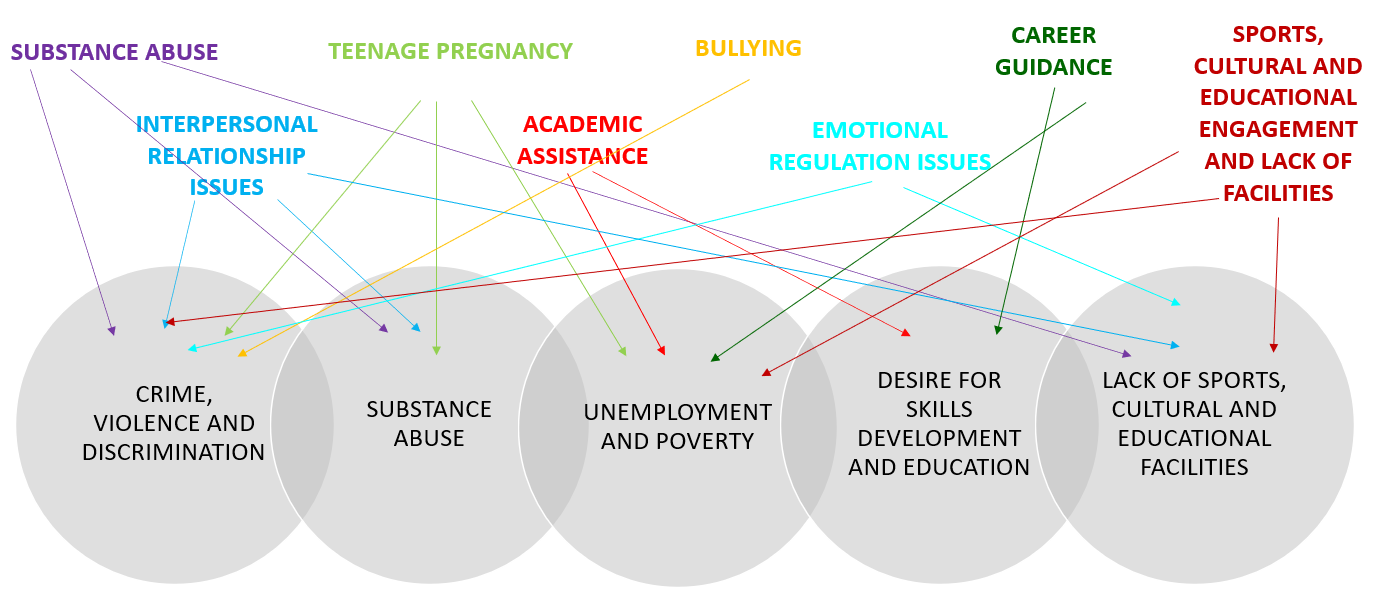
Through the restorative justice which has informed our successful dialogue circles, training provided to our NGOs including our army of young mediators from the township has resulted in the following successes:
- Our trainees have demonstrated their capacity to resolve complex cases with ex-offenders and victims.
- They have reached hundreds of community members through dialogue circles which have had a significant impact on the psychological functioning of community members.
- We have also been able to generate data to develop bespoke interventions relevant to the needs of the various demographic groups.
An Opportune Intervention : Dialogue Circles
Another significant success to note is that over the past year, Khulisa has conducted a dialogue circle with volunteers such as the cleaners of the Jukskei River, the homeless, government officials, corporates, and other NGOs across the country, covering topics such as anti-social behaviour among boys, awareness and self-awareness, bereavement, bullying, conflict, coping with life challenges, crime and crime awareness, depression, discrimination, education, environmental issues, financial constraints, future dreams and goals, GBV, gender roles, LGBTQIA+ acceptance, healing, lack of support and opportunities, living conditions, mental health, parenting, parental challenges, parent-child conflict, and single-parenthood, peace-making, peer pressure, reintegration of ex-offenders, relationships and relationship conflict, stigmatisation, substance abuse, teenage pregnancy, trauma, unhealed wounds, violence, and unemployment. Through these engagements, we have noted a demand for further training to introduce this initiative into all sectors of communities to diffuse anger, address inequalities and provide people with an opportunity to be heard.
Undoubtedly, dialogue is crucial to promoting social cohesion in marginalised communities because it allows community members to share their perspectives, experiences, and concerns in a safe and respectful environment. By engaging in dialogue, people can develop a better understanding of different viewpoints and build empathy and trust with one another. This can help to bridge divides and reduce tensions within the community, leading to greater social cohesion.
In communities where significant conflict and inequality exist, dialogue can help address underlying issues and identify shared goals and values. By bringing together people from different backgrounds and perspectives, dialogue can help to build a sense of common purpose and foster collaboration toward a shared vision for the community.
Dialogue can provide a platform for marginalised and diverse voices to be heard and for community members to work together to address systemic barriers to social, economic, and political equality. By opening channels of communication and providing opportunities for meaningful participation, dialogue can empower community members to take collective action and advocate for change. Dialogue is an essential tool for promoting social cohesion in poor communities where conflict and inequality exist. It can help to build trust, understanding, and collaboration among community members, and provide a pathway toward creating a more just and equitable society.
Another notable advantage is that this form of intervention presents a viable form of income generation for trained NGO representatives to become agents of change in their communities by rendering dialogue circles, whilst simultaneously providing healing and cohesion between previously conflictual groups.
Simultaneously through Khulisa’s Monitoring and Evaluation unit, we are in the process of ‘banking’ a wealth of data specific to multiple factors that are providing us with valuable insights into how we can present to all sectors of society within the local ecology of the community with cross-sectoral programmes that will not only promote social cohesion that will address issues on promoting social cohesion.
Collectively, the NGOs have rolled out approximately 119 dialogue circles reaching an average of 917 people, targeting a range of diverse individuals, such as children and youth, parents, people living with disabilities and their family members, survivors of crime, formerly incarcerated offenders, people recovering from drug addiction, and women cleaning the Jukskei River. An overwhelming 100% of NGO members stated that the training enhanced the quality of their services and offered them the opportunity to assist other community-based entities, for example ADAPT, Alex Youth Team, ANGOF, churches, ECD centres, and victims of violence.
In several cases, the beneficiaries have also master-trained other entities in several provinces with Khulisa’s methodology. Furthermore, there is a need for additional training to broaden their range of restorative justice methodologies and in collaboration with Khulisa, to expand the scope of peace-making within their communities which will lead to enhanced financial sustainability as professional fees will be levied. Finally, as the intensity of dialogue circles increases, there has been a unanimous call for social workers and counselling services to assist with the increased complexity of nature.
The Impact of Dialogue Circles

Building Trust
Created a safe and respectful space for open dialogue that led to increased trust among participants. Trust was essential for honest and vulnerable sharing, allowing for more meaningful conversations.
Constructive Conflict Resolution
Dialogue circles provided a platform for addressing conflicts and tensions constructively. Participants learned new conflict resolution strategies and found common ground with others.
Encouragement to Take Action
Dialogue circles inspired participants to take action beyond the discussion, whether it’s supporting specific causes, becoming more engaged in their community, or advocating for change.
Enhanced Understanding
Participants expressed that engaging in dialogue circles helped them gain a deeper understanding of the topic or issue discussed. The process of active listening and sharing different perspectives broaden their viewpoints and challenged preconceived notions.
Improved Communication Skills
Many participants found that dialogue circles enhanced their communication skills, including active listening, expressing thoughts clearly, and addressing differences constructively. These skills were valuable in both personal and professional settings.
Increased Empathy
Dialogue circles fostered empathy as participants heard personal stories and experiences from others. This emotional connection led to greater compassion and understanding for individuals from different backgrounds.
Personal Growth
Some participants reported personal growth through the dialogue circle process, as it encouraged self-reflection and introspection. Engaging in thoughtful discussions led to a greater sense of self-awareness.
Reduced Stereotyping and Prejudice
By engaging in meaningful conversations, participants challenged stereotypes and prejudices they held about certain groups or individuals, fostering a more inclusive mindset.
Strengthened Community Bonds
Dialogue circles strengthened community bonds by bringing together individuals with diverse perspectives. Participants felt a sense of unity and shared purpose after engaging in these discussions.
Our Call to Action
This document serves as an urgent request for Khulisa to receive funding to enable us to sustain our Peace-Making project in Alexandra, and beyond. We also need to keep up with the demand for us to provide training to government, NGOs, the corporate sector, and municipal entities in other provinces in the absence of funding being available.
The project will be conducted in collaboration with Khulisa’s key partners in Alex, ranging from government officials to NGOs who are involved in both offender rehabilitation and victim empowerment.
The value of this intervention is underscored by UNODC’s keen interest in replicating it in its other social contexts. On that note, the UNODC will be in South Africa to witness our efforts in peace-making. The joint effort will enable the UNODC to reach its research objectives of an increased understanding of the causes of recidivism and the obstacles to rehabilitation. The expansion of the research programme to South Africa contributes to building a sustainable and more comprehensive data collection on prisons worldwide, supplements the research with expert collaboration and advice, and provides both targeted and comparative evidence-based policy advice to reduce reoffending.
In addition, the following needs have been identified for our Alex NGOs and their beneficiaries
- Fencing and Concrete
- Secure storage spaces for tools, equipment, and produce.
- Separate spaces for administration and activities, tailored to different age groups.
- Beneficiaries: Approx. 3,280 people across 8 NGOs.
- Sports Equipment
- Sports and outdoor gym equipment to enhance physical and mental well-being.
- Supports drug prevention programs and motivates youth through sports.
- Beneficiaries: Approx. 6,000 people across 9 NGOs.
- Stationery and Office Supplies
- Computers, printers, internet facilities, and general stationery for administration, documentation, and educational activities.
- Beneficiaries: Approx. 7,500 people across 9 NGOs.
- Educational Materials
- Books, computers, and projectors for extra classes, computer training, and educational programs for both children and adults.
- Beneficiaries: Over 5,000 people across 8 NGOs.
- Food and Nutrition
- Food parcels, cooking facilities, and feeding schemes to support vulnerable families and school-going children through soup kitchens and food programs.
- Beneficiaries: Approx. 3,700 people across 8 NGOs.
- Clothing and Personal Items
- Clothing, shoes, hygiene products, uniforms, and safety gear to boost confidence, restore dignity, and ensure safety during various activities.
- Beneficiaries: Approx. 3,500 people across 9 NGOs.
- Healthcare Supplies
- First aid kits and healthcare supplies for emergencies during sessions and programs.
- Supports Early Childhood Development (ECD) and harm reduction programs.
- Beneficiaries: Over 8,000 people across 8 NGOs.
- Technology and Communication
- Laptops, projectors, Wi-Fi, and other communication tools to bridge the tech gap, improve program delivery, and enhance communication among staff and beneficiaries.
- Beneficiaries: Approx. 7,000 people across 9 NGOs.
- Furniture and Fixtures
- Office furniture and storage solutions to create organized, functional spaces for both staff and beneficiaries.
The project will be conducted in collaboration with Khulisa’s key partners in Alex, ranging from government officials to NGOs who are involved in both offender rehabilitation and victim empowerment.
The value of this intervention is underscored by UNODC’s keen interest in replicating it in its other social contexts. On that note, the UNODC will be in South Africa to witness our efforts in peace-making. The joint effort will enable the UNODC to reach its research objectives of an increased understanding of the causes of recidivism and the obstacles to rehabilitation. The expansion of the research programme to South Africa contributes to building a sustainable and more comprehensive data collection on prisons worldwide, supplements the research with expert collaboration and advice, and provides both targeted and comparative evidence-based policy advice to reduce reoffending.
For more information, contact
Lesley Ann Van Selm | 082 601 2299 | lesleyann@khulisa.org.za | media@khulisa.org.za

